Thứ Bảy, 14 tháng 4, 2012

Flagg's Hollywood Men

James Montgomery Flagg (1877-1960), best known for his "I Want You for U.S. Army" poster, was skilled in oils, watercolors, pen-and-ink, and charcoal. 


He was as famous for portraits as for his illustrations, and he did both straight portraits and caricatures.

Here are a few of his caricature portraits of the movie stars. They prove the notion that the key to a likeness is not the physiognomy, but rather the attitude.
------
James Montgomery Flagg on Wikipedia

Thứ Sáu, 13 tháng 4, 2012

Preliminary Steps

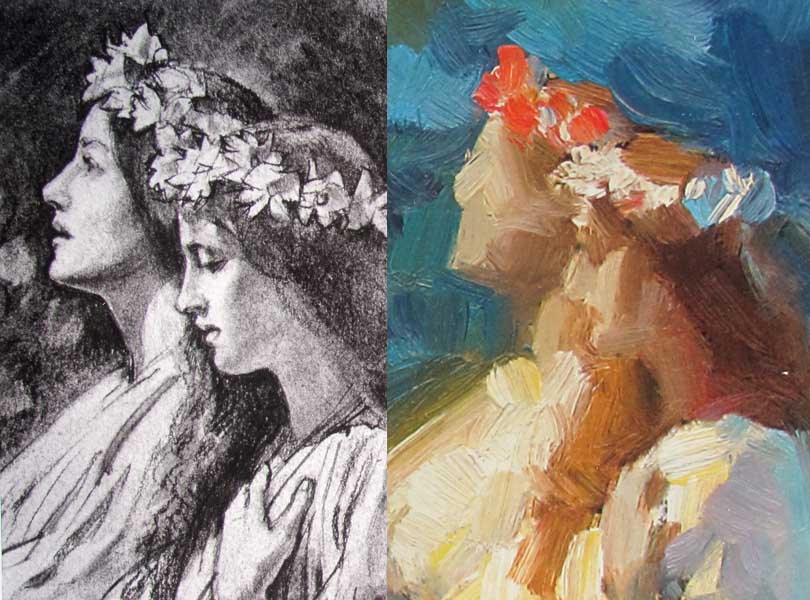
Here are details of two preliminary sketches for the painting "Garden of Hope" from Dinotopia: The World Beneath.


On the left is the "charcoal comprehensive." This half-size drawing, which I drew after completing all the thumbnail sketches and photo reference, allowed me the chance to figure out the basic arrangement of light and dark tones, and how the figures overlapped. It was so easy to erase and change things in charcoal that I felt free to add or subtract elements until I was really sure I had the composition I wanted.

On the right is a very quick color sketch over a photocopy of the charcoal comprehensive. It was painted loosely and quickly with big bristle brushes, forgoing all detail.


With those studies behind me, I felt a lot more sure of myself when it came to painting the final image. There are always so many issues to figure out with any painting, that I find it helps to solve them systematically in advance.
--------
Added later -- for John and Frank, here's one of the early color sketches, before getting models and doing the charcoal drawing. This sketch followed many horizontal compositions that just weren't working.

Thứ Năm, 12 tháng 4, 2012

Rustic Alphabets

The rustic alphabet was one of the novelty fonts that became popular during the late 1800s and early 20th century, during the Golden Age of Ornamental Penmanship.  


Rustic lettering gave a headline a homespun, folksy look. Although some alphabets were designed for mechanical printing, it was ideally suited to pen-and-ink originals. During those years, photomechanical reproduction allowed original penwork to be reproduced accurately.   

Like the related trends of rustic picture frames and furniture, rustic lettering can be seen as a reaction to the rapid growth of standardization and industrialization, which was replacing the authentically hand-made.

A few tips if you want to try drawing rustic:
1. Practice by drawing real branches, twigs, and leaves until the rhythms become automatic.
2. Begin by penciling in an even, regular letterform to use as a basis, such as the Old English above.
3. Be free with the smaller twigs and leaves, and let them occasionally cross in front of the main trunks, but keep the little stuff light so it doesn't interfere with readability. 

Sources for these examples Here and Here 

Thứ Tư, 11 tháng 4, 2012

Robust Robot

(Video Link) The RHex robot has six spinning legs and a bulldog determination. It can keep on going even after it gets flipped over. It can tackle rocks, fallen logs, and shallow water, and has the good sense to turn around in a narrow cave.


It's hard not to think of the pendulum-style walking leg movements as the ideal design concept for legs, because natural analogues provide the default setting for our imaginations. Same problem for early airplane designers who kept thinking of flapping wings.

Thứ Ba, 10 tháng 4, 2012

Voice of the Teacher

Last Saturday I had the privilege of painting alongside the artist and teacher Max Ginsburg (b. 1931)

He drove up with several of his students to take part in a six-hour figure painting session hosted by Garin Baker's Carriage House Atelier near Newburgh, New York. Max is in the lower right, below.


As we painted, Max offered helpful advice to his students. "Big artists use big brushes," he said as we were all beginning.


Here is Max's six-hour study. The light was set up so that so that it was stronger on the top half of the figure, and he was attentive to the value-mixing required to get the progression of tone. "There's a build up from this tone to that one," he said. He explained how he was painting across the form, rather than just along it, and how he softened certain edges, such as along the shin and the calf.

With some of the students, he worked directly on their paintings, but he left problems for them to solve. "I'll leave something for you to do. I think you'll get this by the time you're eighty. That's how old I am."


Here's my painting. Although I'm not one of his students, I was hanging on Max's every word because I've never heard the voice of a painting teacher before.

It wouldn't be accurate to say I'm self-taught. I was taught by people who were already dead when I found them: Andrew Loomis, Norman Rockwell, Harold Speed, Solomon Solomon, and Howard Pyle. Fortunately their words have come down to us through the printed page. As an art student, I read those books as if my life depended on them. I cherished all their words, but I couldn't hear their voices.


I finished my painting a little early, and had a half hour left at the end, so I turned and drew Max, thinking of the great gift his teaching has been to the thousands of students he has nurtured over the years.

Carriage House Atelier
Max Ginsburg
----
Thanks, Susan Daly Voss and Eric Wilkerson for the photos.

Thứ Hai, 9 tháng 4, 2012

Menzel's Maquette

Here's a painting by Adolph von Menzel called “The Disturbance,” which shows the response of two finely dressed women to the arrival of an unexpected visitor. 


According to a primary account, "To study the candle lighting accurately he had constructed a tiny parlour with a small piano and two little lights and as well a tiny dressed puppet. He already begun the painting in 1843. On the first sketch a young lady is walking up and down in the room. He later changed his idea into an unexpected visit in the background."

Thanks Christian.

Chủ Nhật, 8 tháng 4, 2012

Meet Rosebud

There's a new life down on the farm. Her name is Rosebud. She's a miniature-horse filly, and she's less than two weeks old.


She has four modes, which she alternates every ten minutes: 1. Running at top speed, 2. Nibbling on everything, 3. Nursing to refuel, and 4. Napping in a sunbeam.


I tried to catch her during nap mode for a watercolor pencil portrait. When I was finished, she hopped up in nibble mode and wanted to know all about the sketchbook.

Happy Easter, folks!
------
Previously on GJ: The Belgian filly Flashy Princess (compare her size)